
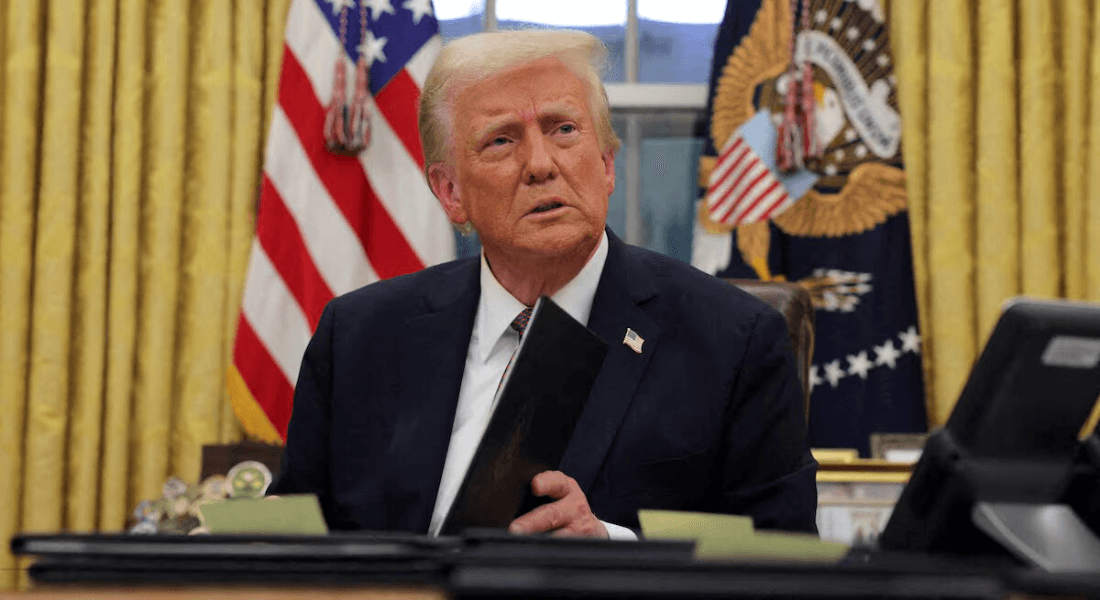
2025 was the year the second term of Donald J. Trump as President of the United States started. If Trump’s first term in 2016 signified the discontent in the States, his second term is a symptom of a nervous breakdown. I think that 2026 will be the year the nervous breakdown of the country becomes more visible global. we are heading towards trouble.
Trump’s arbitrary tariff decisions determined the course of the global policy debate in 2025. The move from multilateral consensus building to bilateral deal making was shockingly fast, and that was just the beginning.
Why? When I used to visit Washington, D.C. in the past, and talked to people about the steps to be taken to improve relations with Turkey, there was a standard talking point I would always encounter: “America is not like Turkey” my partners would tell me, “here we don’t have one man who decides about everything. We have a Congress, as well as many institutions that need to be taken into account. It is not that easy to reach a decision. It takes time.”
Yet about four weeks ago, when I was in the States, I was horrified to see that the message has changed completely. “We are also against the presidential tariff decisions” my partners this time noted one after the other, “but now we have one man who makes all decisions and we are looking for an effective communication strategy for this new era, conveying the message without hurting the feelings of the sole decision maker.” Now this is something new in D.C. 2025 was only the dress rehearsal of what is waiting for us in 2026. Fasten your seat belts. As someone with deep experience in Ankara, I can tell you that it’s going to be turbulent.
Look how the year has started. Just on the third day of 2026, the President of Venezuela was abducted from Caracas by a unilateral American military operation. On January 10th, the DOJ charged Fed Chairman Powell with corruption. Powell declared that the case is just an attempt to force the Fed to comply with Trump’s desire to lower interest rates. Just in its first two weeks, 2026 is already telling us that it’s going to stress test the national and international policy infrastructure.
The most important thing to keep in mind is that the nervous breakdown in Washington opens up Trump’s room for maneuver. Let me help you keep track of the deep discontent in the States: just follow the book titles of the best sellers over the years. We have moved from “The World is Flat: A Brief History of the Twenty First Century” by Thomas Friedman, which was published in 2005 to “The World’s Worst Bet: How the Globalization Gamble Went Wrong (And What Would Make It Right) by David Lynch, published in 2025 ”. A quantum leap in two decades from extreme optimism to deep pessimism.
It’s all about China, of course. Americans seem to be obsessed with the success of Chinese development. Globalization was started with the objective of making the United States stronger. Yet China has become the major beneficiary of the process. Hence the deep disillusionment and subsequent nervous breakdown in the States.
This is understandable. In 2005, the time of the Friedman book, the nominal GDP of the US was around $13.04 trillion, while that of China was $2.32 trillion, meaning that the US economy was about 5.6 times larger than the Chinese economy in nominal terms.
In 2025, the US economy is still larger than China’s economy. Its nominal GDP is $30.5 trillion, while that of China is $19.2 trillion. This time however, the US economy is only 1.6 times China’s economy. China’s economy grew faster in the last two decades. Hence the disillusionment and the subsequent nervous breakdown.
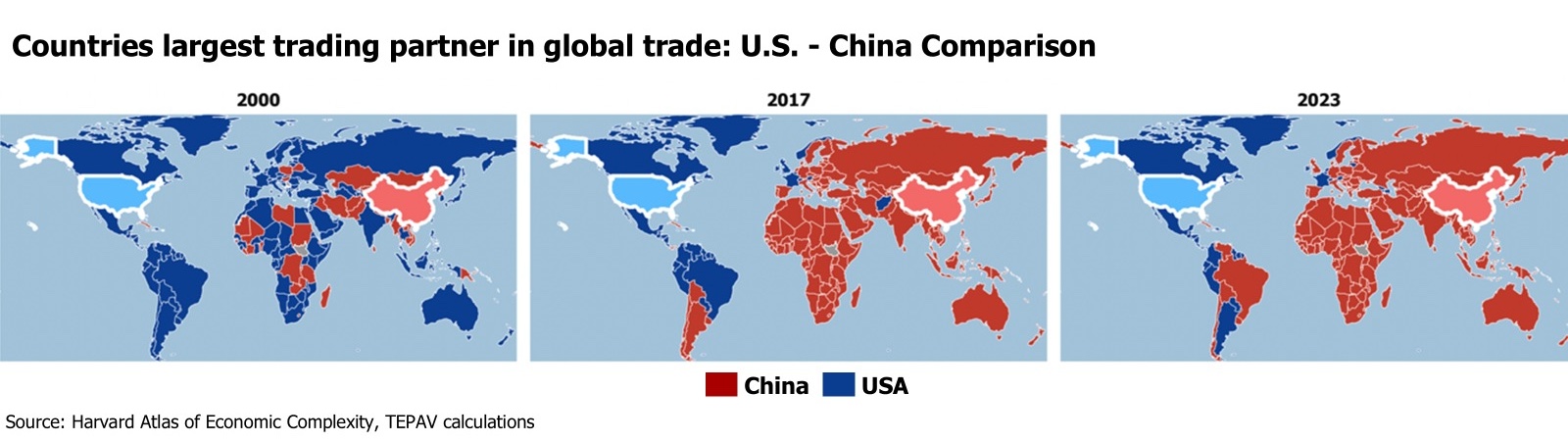
This is not only about the relative size of the American and Chinese economies, however. Just have a look at which one of them is the number on trading partner of third countries. In 2000, the World is overwhelmingly blue, the color for the USA in Graph 1. In 2017, Chinese red took over America’s blue, and by 2023, the world was overwhelmingly red. Here is the reason for deep disillusionment and the subsequent nervous breakdown.
Globalization has moved the production centers in the West, including the United States, to the East, mainly to China. With the movement of factories, American workers lost their jobs while China has moved its population from rural to urban areas by creating industrial jobs. Workers in the States have lost.
This relative decline in the performance of the US economy led to the mood change in the US and brought Trump to power. Let me put this into perspective: When I was a kid, Fidel Castro of Cuba was the symbol of a backlash against globalization. Now we have Trump and MAGA.
If Castro’s Cuba was the occasional pothole along the road, Trump now is the drunk driver sitting next to you. Welcome to the age of global reckless driving. Let me elaborate.
Trump’s arbitrary tariff decisions increased uncertainties regarding global trade. It is not only the direct tariff decisions and the related bilateral deal making, but also the indirect effect of tariffs on other countries. When the US raise the tariffs on Chinese goods, this may have a direct effect on your exports in third countries as the Chinese companies tend to dump their goods that cannot be sold to the US to other markets. So more turbulence.
Regarding Turkey, for example, 2026 is the year for CBAM, carbon border adjustment mechanism of the EU, to become operational. CBAM itself is an additional tax on Turkish exports. Now we also have Trump with so many arbitrary decisions, raising costs for Turkish exporters.
So if you are living in a country like Turkey, expect more turbulence in 2026. It’s not only about facing the direct and indirect impact of arbitrary Trump tariff changes, or CBAM’s impact, but also the recent Trump attempt to create uncertainty in financial markets to try to devalue the US dollar by creating a confrontation with Fed.
Turkey’s structural savings deficit means that it is dependent on US financial markets. Fluctuations on that front is bad news for Turkey in 2026.
So, 2026 is going to be a turbulent year for Turkey, with uncertainties rising in both international trade and financial markets.
This commentary was published in Substack.