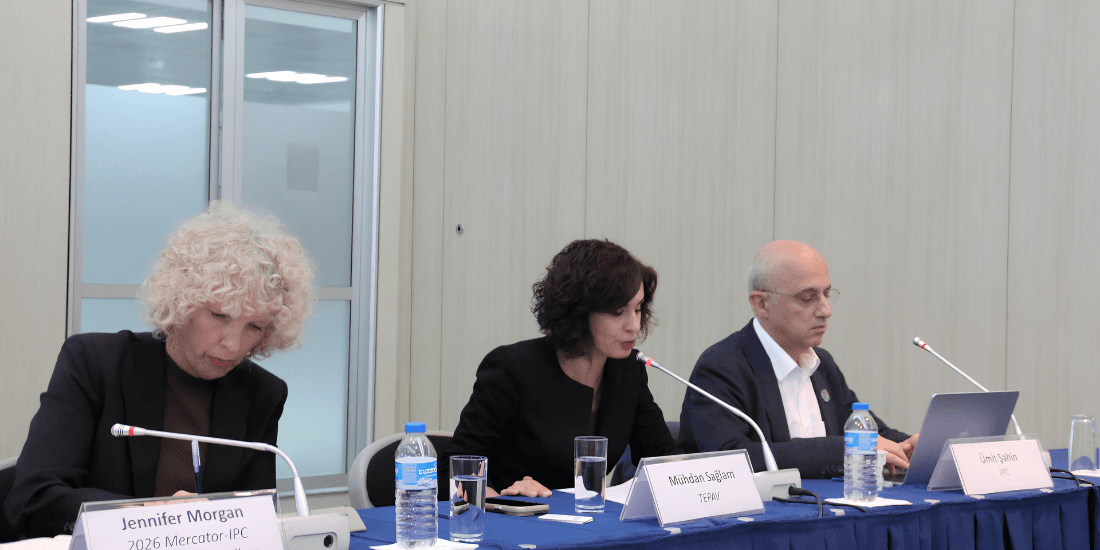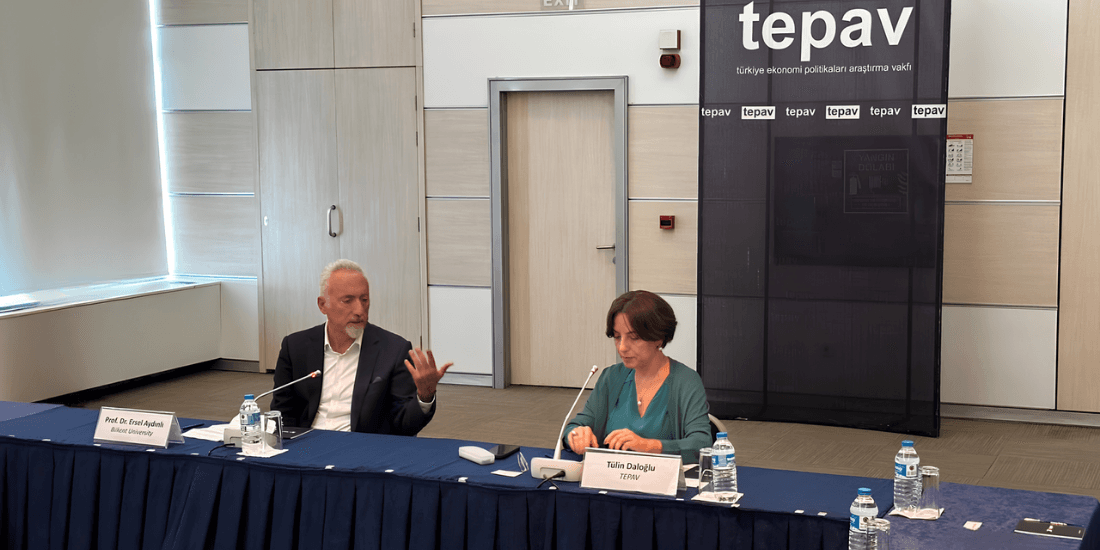
The meeting, part of TEPAV’s four-part series, was held in Ankara on October 26, 2026. The event featured Professor Ersel Aydınlı of Bilkent University as the speaker and was moderated by Tülin Daloğlu, Director of TEPAV’s U.S. Center.
The opening question was how far the midterm elections could reasonably be viewed as an existential test for American democracy. The discussion explored the relationship between party competition and broader changes affecting the functioning of institutions. Particular attention was paid to the president’s decision to place his own political future at the center of an election in which he is not directly on the ballot, as well as debates over the legitimacy of election results.
Winning a Majority in Congress Is Not Enough to Change Policy
Participants noted that potential shifts in the majorities in the House of Representatives and the Senate could complicate the president’s initiatives without enabling the opposition to reverse all of the administration’s policy choices. The powers of the two chambers, the size of their majorities, and the president’s veto power were identified as factors determining whether electoral success translates into policy change.
Another scenario discussed was that a president weakened by electoral losses might seek to compensate for his diminished political space in Congress by exercising executive powers, rather than pursuing compromise. Participants observed that, despite pressure on constitutional limits, checks such as the courts, political mechanisms, and the press continued to perform their functions.
A Democratic majority in the House of Representatives could make more effective use of oversight and investigative powers, while impeachment efforts could also emerge. Participants noted that Congress’s influence over spending could extend to foreign policy, suggesting that scrutiny of the cost of military operations against Iran could make those operations harder to sustain.
Cost-of-Living Concerns Underpin Trump’s Political Influence
Participants argued that Trump’s political future should be considered separately from the societal demands underpinning his support. The rising cost of living, housing costs, student debt, and the middle class’s struggle to maintain its standard of living were identified as sources of discontent that had begun to accumulate before Trump’s rise.
The weakening prospects of supporting a family on a single income, owning a home, and feeling confident about children’s futures were said to have politicized groups that had previously shown little interest in politics, making them angry and more demanding. Participants noted that a sense of economic loss reinforced narratives claiming that prosperity was being diverted away from voters at home and transferred abroad. Criticism of free trade, foreign aid, and international commitments had thus become intertwined with concerns about making ends meet.
Immigration, cultural backlash, and distrust of elites were also discussed in this context. Given successive political leaders’ failure to respond adequately to mounting problems, participants stressed that it would be insufficient to view current developments as a temporary phenomenon confined to Trump.
U.S. Strategic Priorities Extend Beyond Individual Presidents
Participants argued for distinguishing the president’s rhetoric and methods from the United States’ long-term interests. China’s rise, Europe’s position, and the preservation of American primacy were described as elements of a broader institutional agenda extending beyond day-to-day political choices. The discussion examined the influence of capital, finance, and the bureaucracy on policy, with campaign finance cited as one area where the weight of money in politics is particularly visible.
The discussion also considered whether a Democratic administration’s renewed emphasis on the liberal international order and soft power would produce fundamental policy changes on issues such as Iran and Gaza. Drawing on the examples of Venezuela, Iran, and the North Atlantic Treaty Organization (NATO), participants noted that strategic priorities might not change as quickly as the language and instruments employed by different administrations. They also recalled that the United States had used military force under both Democratic and Republican administrations.
Washington Expects Europe to Devote More Resources to Security
Participants noted that tensions between the United States and Europe could not be explained solely in terms of Trump or Russia. As concerns over housing, infrastructure, and living costs became more visible among the American public, spending on security abroad was coming under greater scrutiny.
Even a more conciliatory administration could ask Europe to devote more resources to its own security. Demands for more favorable trading terms and broader sharing of the financial burden of international institutions could also persist. Participants therefore emphasized that a change of administration would not automatically restore earlier patterns in transatlantic relations.
The United States Seeks to Turn Technological Superiority into Economic Strength
Attention then shifted to how resource constraints limit foreign policy options, focusing on U.S. debt and the sustainability of investment in artificial intelligence. Participants suggested that the United States was seeking to reduce spending while increasing its capacity to generate revenue through its advantage in advanced technologies. They noted that this transformation would take time, raising the question of how external commitments would be sustained during the transition.
A U.S. focus on domestic problems could reinforce perceptions in other countries that they have more room for maneuver. Türkiye and Iran were cited as examples of countries seeking more autonomous foreign policies.
In the discussion of industrial policy, participants pointed to similarities between the United States and China in their use of public resources to pursue specific technological objectives. At the same time, they highlighted the difficulties of establishing public oversight over the vast and mobile capital held by financial technology firms, cryptocurrency businesses, and major technology companies.
Türkiye’s Democratic Experience Could Strengthen Bilateral Relations
The discussion turned to whether Türkiye–U.S. relations had become excessively centered on Trump and driven by specific transactional exchanges. Participants suggested that, although bargaining currently dominated the relationship, the intellectual appeal generated by Türkiye’s efforts toward modernization, democratization, and integration with Europe had not entirely disappeared.
Regional tensions were said to be heightening the need for security and hard power in the short term, with Türkiye among the actors capable of meeting that need. Over the longer term, the high costs of conflict could renew interest in international institutions and cooperation. Participants emphasized the importance of considering Türkiye’s contribution together with its democracy, modernity, and soft power capacity, and of hard power underpinning this political and intellectual appeal.
The next meeting in the series, scheduled for November 12, will assess the midterm election results.