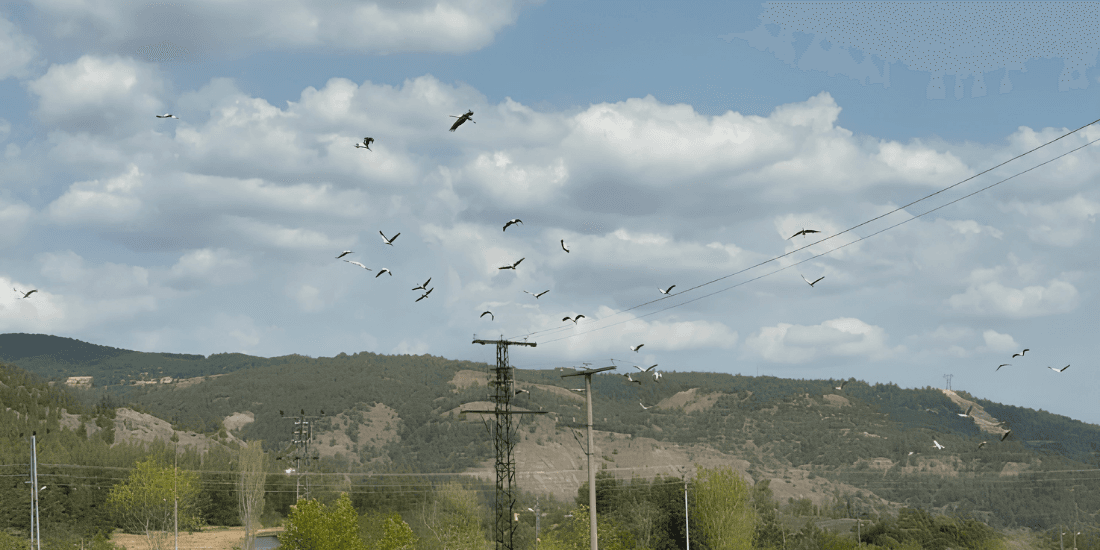

The evaluation note published by TEPAV states that the discovery of numerous dead and injured storks along a railway electrification line in Küçükçekmece, Istanbul, in August 2026 brought attention to risks in areas where electrical infrastructure intersects with migration routes.
Titled “Storks, Power Lines and Fire Risk”, the note does not treat the incident merely as an isolated case within the remit of Turkish State Railways (TCDD). Instead, it examines the different risks that railway catenary systems, electricity transmission lines and distribution networks pose to birds.
Storks make infrastructure risks visible
The note explains that Türkiye lies along the eastern migration route of white storks between Europe and Africa, identifying storks as an indicator species that makes risks associated with electrified infrastructure visible.
It distinguishes between two risks birds face on power lines: collision and electrocution. It therefore recommends combining measures such as insulation, line markers, safe perches and nesting platforms according to infrastructure type and site conditions.
The share of fires attributable to bird contact remains unknown
The note explains that birds exposed to electric current do not always cause fires, but heat generated by electrical arcing or short circuits can ignite feathers and dry nesting material.
In Türkiye, fires associated with energy infrastructure accounted for 3.38% of all forest fires and 20.44% of the total area burned during 2012–2021. However, the note states that the share of energy-related forest fires attributable to birds cannot be calculated because existing records do not distinguish bird contact from other energy-related causes.
A national bird safety programme is proposed
The evaluation note recommends establishing a national bird safety programme that incorporates migration routes into infrastructure planning and regularly measures the outcomes of interventions.
It calls for seasonal risk maps that bring together migration bottlenecks, wetlands, feeding and roosting sites, and the characteristics of electrical infrastructure. It also stresses the need for separate technical standards for railway catenary systems, transmission lines and distribution networks.
The note further recommends that TCDD prepare and publish a comprehensive incident report on the Küçükçekmece case in cooperation with the relevant nature conservation authorities and specialist organisations. The report should specify the scope of the field survey, the number of dead and injured birds, hazardous catenary components, measures taken and the work timetable.
It emphasises that the success of these measures should be assessed not only by the number of devices installed or poles retrofitted, but also by changes in bird deaths, network faults, power outages and fires.
Electrification cannot be considered separately from biodiversity
The note highlights that the expansion of electrical infrastructure under the low-carbon transition cannot be assessed independently of its effects on biodiversity and land.
It explains that the three Rio Conventions, namely the United Nations Framework Convention on Climate Change (UNFCCC), the Convention on Biological Diversity (CBD) and the United Nations Convention to Combat Desertification (UNCCD), provide a complementary planning framework for bringing climate, biodiversity and land objectives into the same investment decision.
The 2026 calendar offers an opportunity for synergies among the Rio Conventions
The successive conferences of the parties (COPs) to the three Rio Conventions across the wider Eurasian region in 2026 offer an important opportunity to translate cooperation among the conventions into practice.
Following UNCCD COP17, held in Ulaanbaatar on 17–28 August, the biodiversity-focused CBD COP17 is scheduled for 19–30 October in Yerevan, while UNFCCC COP31, addressing the climate agenda, will take place in Antalya on 9–20 November.
This calendar could enable the land, rangeland, drought and restoration issues discussed in Ulaanbaatar to be considered alongside biodiversity in Yerevan and climate adaptation and implementation tools in Antalya. The electrical infrastructure risks highlighted by stork deaths constitute one concrete area of action requiring these three dimensions to be addressed together.
You may read note from here.