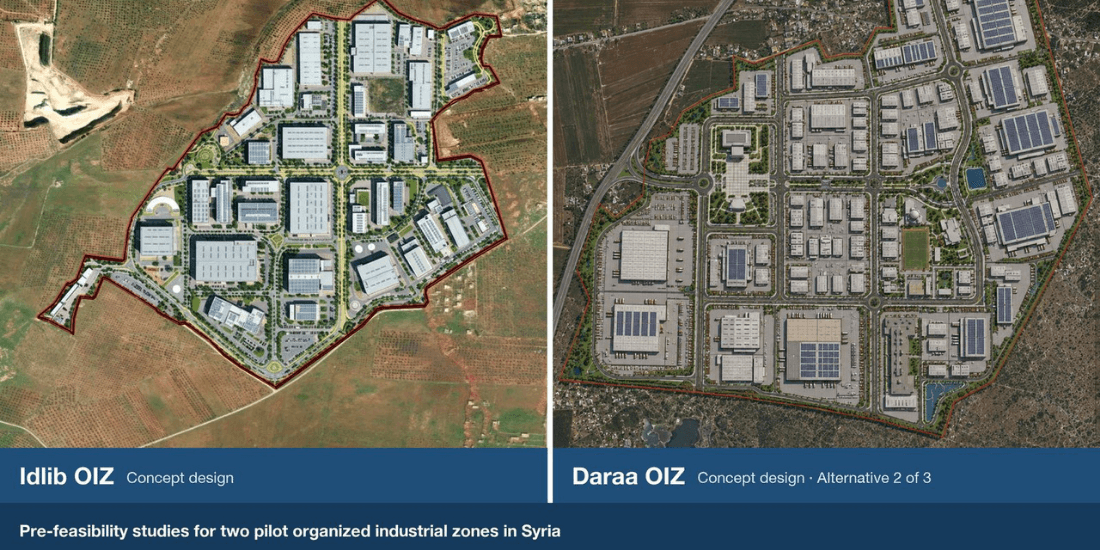
Concept designs from TEPAV's pre-feasibility reports for the proposed Idlib and Daraa OIZs. The Daraa design shown is the second of three alternatives.
The Economic Policy Research Foundation of Türkiye (TEPAV) has prepared two pre-feasibility reports under the title "Post-Conflict Economic Recovery in Syria through an Organized Industrial Zone Approach" to assess whether and how pilot organized industrial zones (OIZs) could be established at two sites in Syria. The Idlib report, requested by Syria's General Authority for Borders and Customs (formerly the General Authority for Land and Sea Ports), covers a site near the town of Saraqib. The Daraa report, requested by the Daraa Governorate, covers a site in southern Syria. The reports assess each site's location, land status, infrastructure and ground conditions and present preliminary zone designs. They draw on field visits, information obtained from local authorities, and TEPAV's Survey on Business Conditions in Syria.
The OIZ model concentrates scarce resources in selected production hubs
The reports propose a spatially concentrated industrial development model for Syria, where unreliable access to essential services and high uncertainty constrain the recovery of production. Zones with completed infrastructure, clearly defined security arrangements and single-window administrative procedures are expected to reduce investors' risk perception.
53.9 percent of Syrian-partnered firms are considering opening a business in Syria
According to the reports, Syrian-partnered companies operating in Türkiye could play a significant role in Syria's economic revitalization. Of the 34,210 Syrian-partnered companies established since 2010, approximately 30,135 are active and 5,123 operate in manufacturing. In the survey TEPAV conducted in 2025 with 1,024 Turkish and 1,005 Syrian businesspeople in Adana, Gaziantep, Hatay, Kahramanmaraş, Kilis, Mersin and Şanlıurfa, 53.9 percent of Syrian-partnered firms said they were considering opening a business in Syria.[1] The corresponding figure in the 2018 survey was 28.3 percent.
In the same survey, 94 percent of Syrian-partnered firms rated water and electricity infrastructure, 93 percent security conditions, 92 percent access to banking services and 91 percent internet infrastructure as a medium- or high-level barrier. On this basis, the reports underline that investment decisions depend on the availability of secure industrial areas with completed infrastructure.
The Idlib site lies next to the junction of the M4 and M5 highways
The Idlib report, dated November 2025, assesses approximately 1 million m² of state-owned land with Free Trade Zone status as the site for the pilot OIZ. The site is around 600 meters from the junction of the M4 and M5, Syria's two main highways, approximately 20 km from Idlib city center and 50 km from Aleppo. The road connection of roughly 100 km to the Port of Latakia and the proximity of Turkish border gates are among the site's logistical advantages.
Based on a field visit conducted on 2–3 November 2025, the report notes that electricity is supplied 24 hours a day and that access to groundwater appears possible. Wastewater, stormwater drainage and natural gas infrastructure, however, will need to be planned from scratch. The flat, rocky limestone plateau offers high bearing capacity for industrial structures but may raise excavation costs. The preliminary design combines industrial plots with administrative units, a vocational training center and social facilities.
Economic activity in Daraa has surpassed its pre-conflict level
The Daraa report, dated August 2026, assesses the site proposed for the pilot OIZ near Izra. Satellite-based night-time lights data show that Daraa's index, with January 2012 taken as 100, reached 103.3 in June 2026, making it the only series in the comparison to have surpassed its pre-conflict level. The index stood at 92.6 in Aleppo, 97.9 in Damascus and 96.1 for Syria as a whole.
The proposed site is approximately 2.5 km from the Damascus–Amman international highway, 75 km from Damascus and Damascus International Airport, and 60 km from the Nassib border crossing with Jordan. A line that forms part of the historic Hejaz Railway passes around 2 km from the site but is currently non-operational. The report notes that, if rehabilitated and connected to the OIZ, the line could turn the area into an intermodal road–rail logistics hub. The wider site covers 14 million m² of state-owned land, with an initial phase of 1.5 million m².
A proposed production network linking Türkiye, Syria and Jordan
The Daraa report points to a degree of complementarity between the Syrian and Jordanian economies. In 2023, fruits and nuts accounted for 53.2 percent of Syria's exports to Jordan, while Jordan mainly supplied Syria with food-processing inputs, plastics and electrical equipment. Türkiye could join this structure as a supplier of machinery, packaging materials and production technologies, enabling goods processed in Daraa to reach Syrian, Jordanian and Gulf markets. The trilateral transport agreement signed by Türkiye, Syria and Jordan in April 2026 is expected to strengthen this model.
Electricity in the area is available for approximately 10–12 hours a day, and network water is supplied every other day for four to six hours. The report therefore recommends planning the OIZ as an integrated infrastructure project. Three preliminary design alternatives were prepared: the first is oriented towards agro-industry, the second towards general manufacturing and logistics, and the third towards chemical-related medium-scale production.
The next step is a detailed feasibility stage
Both reports stress that success will depend on a predictable legal, institutional and financial framework. Tax and customs regulations, land-use rights, licensing procedures and the OIZ management model need to be clarified together with the relevant Syrian institutions. Financing is recommended to combine public resources, private investment and international development finance.
The reports recommend proceeding to a detailed feasibility stage covering engineering designs, a financing plan and the legal–institutional framework. If implemented successfully, the pilot OIZs could serve as a model for other regions of Syria.
You can access the reports via the links below.
➔ Pre-Feasibility Study for the Idlib Organized Industrial Zone (OIZ)
➔ Pre-Feasibility Study for the Daraa Organized Industrial Zone (OIZ)
➔ To view the report in Arabic, please click the following link. (للاطلاع على التقرير باللغة العربية، يرجى الضغط على الرابط التالي.)
[1] The findings of TEPAV’s Survey on Business Conditions in Syria are presented in Sak, G., Güven, S., Dündar, M. M., Yücel, B., & Küpeli, B. (2025). How to Design an Economic Recovery? A Strategy Proposal for Syria. Ankara: TEPAV.