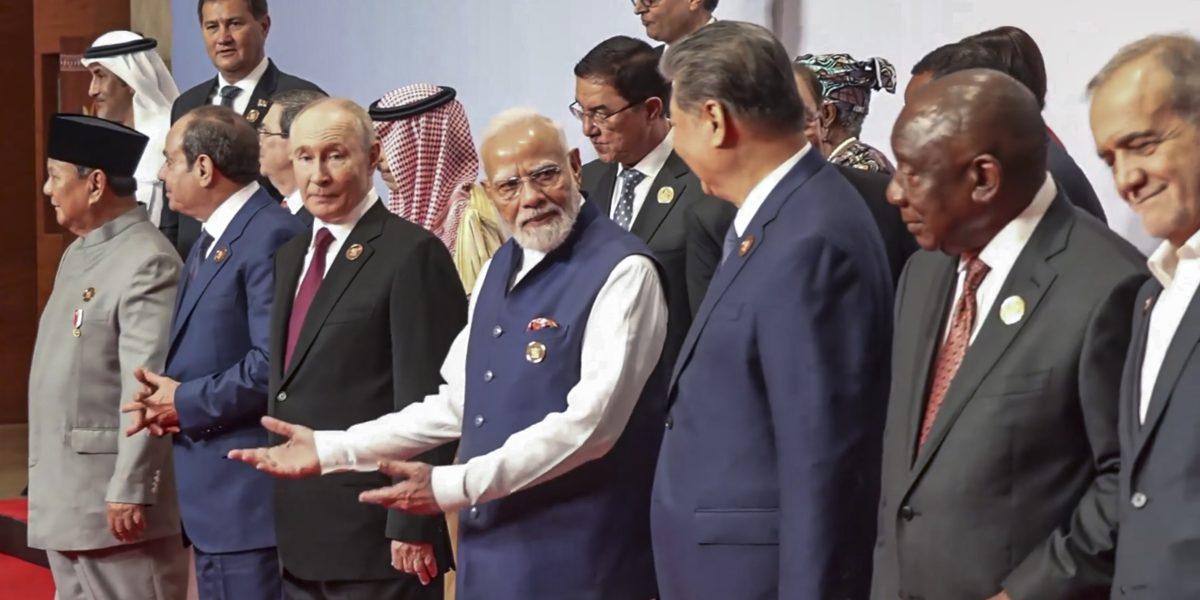
Brazil, the Russian Federation, India, China and South Africa (BRICS) are a significant informal grouping of major emerging countries that decided to cooperate on political, economic and development issues two decades ago. The acronym BRIC was coined by Goldman Sachs in 2001 to describe four of these economies (excluding South Africa) as major emerging economies at the turn of the 21st century. They subsequently began formalizing their cooperation in 2006 on the sidelines of the UN General Assembly in New York and held their first Summit in Yekaterinburg, Russia in 2009.
South Africa joined in 2011, turning it into the BRICS Group. The group expanded again in 2024, when Egypt, Ethiopia, Iran and the United Arab Emirates (UAE) became full members. Indonesia joined as a full member in January 2025 making the BRICS an eleven-member grouping. It now has ten additional partners, agreed in 2025 and 2026 (Belarus, Bolivia, Cuba, Kazakhstan, Malaysia, Nigeria, Thailand, Uganda, Uzbekistan, Vietnam).
The Main Reasons for the Creation of the Original BRIC(S)
One of the main reasons for the creation of the original BRIC Group was that global institutions created in the aftermath of World War II no longer adequately reflected the distribution of economic and political power in the world.
The particular focus of the BRIC founders in 2006 (Presidents Lula of Brazil, Hu Jintao of China and Medvedev of the Russian Federation and Prime Minister Manmohan Singh of India), was on the four institutions vital to global governance - the United Nations (UN) Security Council, the International Monetary Fund (IMF), the World Bank (WB) and the World Trade Organization (WTO).
You may read note from here.
This article is a slightly updated and modified version, with a changed title, of an Op Ed by the same author which first appeared in The Wire, India on 16 September 2026, with the heading Did the BRICS Advance their Founders’ Vision and Objectives in New Delhi?